
EN
Astronomical observations show that carbon dioxide (CO₂) is widespread across planetary bodies and often coexists with water (H₂O), making it a key player in planetary carbon and water cycles. How these molecules remain stable under the extreme pressures and temperatures inside ice giants—and how they influence magnetic fields and deep material circulation—has long puzzled scientists. A team of HPSTAR researchers at the Center for High Pressure Science and Technology Advanced Research (HPSTAR), led by Dr. Qingyang Hu, has now made a breakthrough. Published in Science Advances, their study demonstrates that CO₂ and H₂O react inside ice giants to form two stable carbonic compounds: carbonic acid (H₂CO₃) and orthocarbonic acid (H₄CO₄). Under the extreme conditions of planetary interiors, these compounds enter a superionic state, forming “hydrogen–carbon double superionic channels.” This discovery offers a new framework for understanding ice giants’ unusual magnetic fields and the coupled transport of carbon and water deep within these planets.
Hydrogen, carbon, oxygen, and nitrogen are the most abundant and chemically versatile elements in the solar system. Their combinations form molecules such as H₂O, CO₂, CH₄, and NH₃, collectively known as planetary ices or light-element ices. Ice giants—most notably Uranus and Neptune—are primarily composed of these ices, distinguishing them from gas giants like Jupiter and Saturn. Observations confirm that CO₂ and H₂O are widely distributed on their surfaces and interiors, where they play crucial roles in planetary dynamics.
While laboratory studies had shown that CO₂ and H₂O react under high pressure to form stable carbonic acid, the structure, dynamics, and physical properties of these compounds under the extreme conditions of planetary interiors remained unknown.
To address this, Hu’s team applied first-principles structure prediction and ab initio molecular dynamics simulations to the CO₂–H₂O system under pressures of 0–500 GPa and temperatures of 500–6000 K. They found that CO₂ and H₂O form two thermodynamically stable compounds: H₂CO₃ and H₄CO₄.
With increasing pressure, H₂CO₃ evolves from a molecular crystal into one-dimensional chains, then two-dimensional layers, and finally a three-dimensional network. At higher temperatures, hydrogen atoms migrate within layers and eventually reach full three-dimensional diffusion. At still higher temperatures, carbon atoms also diffuse, forming a “double superionic state,” in which both hydrogen and carbon ions move freely while oxygen atoms create a stable framework with porous transport channels. Green–Kubo calculations show that ionic conductivity in this state is significantly higher than previous estimates, emphasizing the importance of ion–ion correlations. H₄CO₄ undergoes similar superionic transitions, though its ion diffusion is more isotropic.
Uranus and Neptune have some of the most unusual magnetic fields in the solar system: non-axisymmetric and non-dipolar. Traditional planetary dynamo models struggle to explain this. The discovery of H₂CO₃ offers a new perspective: its layered structure causes hydrogen ions to diffuse differently along and across layers, even in three-dimensional diffusion. This anisotropy can generate dual-component magnetic fields, consistent with the complex magnetism observed in these planets.
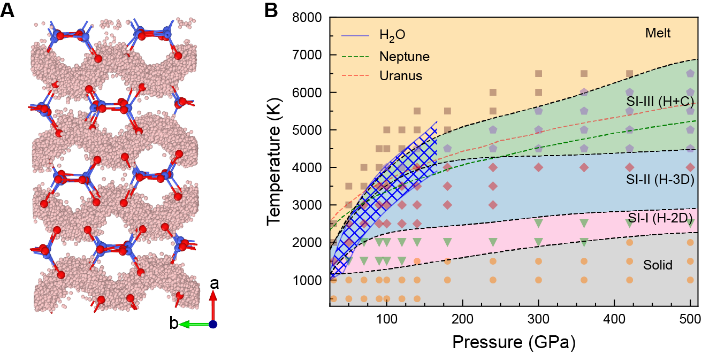
Caption: (A) Hydrogen atom diffusion trajectories of H₂CO₃ in the two-dimensional superionic state; (B) High-pressure, high-temperature phase diagram of H₂CO₃.
Conventional models suggest that reduced carbon species, such as methane, decompose into diamond and hydrogen deep within ice giants, resulting in irreversible carbon deposition at the core–mantle boundary. Hu’s team proposes a new mechanism: diamonds can react with water in the mantle and with iron at the boundary to form superionic H₂CO₃ and H₄CO₄. The hydrogen–carbon double superionic channels allow previously trapped carbon to move again, enabling active carbon circulation. Weaker H–O bonds in carbonic acids mean that superionic transitions occur at lower temperatures, making these states more widespread and influential in planetary evolution.
"Hydrogen, carbon, and oxygen are the most abundant elements in the solar system, and their high-pressure chemistry directly shapes planetary evolution," said Dr. Hu. “Our discovery of a double superionic conductor shows that carbonic acid can transport ions and carbon, conduct electricity, and explain magnetic fields—linking multiple deep interior mysteries of ice giants."
天文观测证实,二氧化碳(CO2)广泛存在于各类行星天体中,且常与水(H2O)共存,是影响行星碳循环和水循环的重要挥发分。在冰巨星深部的极端高温高压环境下,CO2与H2O如何稳定共存,以及如何调控行星磁场与内部物质循环,长期以来一直是行星科学领域悬而未决的重大谜题。北京高压科学研究中心胡清扬研究员团队在国际顶尖期刊《科学·进展》(Sci. Adv.)发表突破性成果,首次明确:冰巨星内部的CO2与H2O会发生反应,形成碳酸(H2CO3)与正碳酸(H4CO4)两种稳定化合物;这两种碳酸在行星深部的极端温压条件下,会以超离子态形式存在,进而形成“氢-碳双超离子通道”,为破解冰巨星独特磁场成因、阐明碳-水耦合输运规律及深部物质循环机制,提供了全新的科学解释。


自由 Freedom
合作 Collaboration
顶尖 Excellence