
EN
New research from a team of scientists led by Dr. Duckyoung Kim at the Center for High Pressure Science and Technology Advanced Research (HPSTAR) discovered, through crystal structure prediction and first-principles calculations, a pressure-driven hydrogen site transfer mechanism in wadsleyite at around 410 km depth—H⁺ preferentially migrates from Mg²⁺ sites to Si⁴⁺ sites. This transition is accompanied by a significant decrease in wadsleyite’s electrical conductivity, implying that ignoring this hydrogen migration effect could lead to substantial errors in estimating the water content of the mantle transition zone based on conductivity. In addition, the study found that at temperatures above 2000 K, hydrous wadsleyite and ringwoodite exhibit a dual superionic state, in which H⁺ and Mg²⁺ both show high ionic mobility. This phenomenon has significant implications for material transport, electrical conductivity, and geomagnetic field generation in the Earth. The related findings were published in Nature Communications.
The Earth’s mantle transition zone, located between 410 km and 660 km depth, is recognized as a major internal water reservoir, with its water content directly influencing the global water cycle, mantle dynamics, and volcanic activity. For a long time, scientists have estimated the water content of the mantle transition zone through conductivity measurements. However, estimates based on the conductivity of hydrous wadsleyite and ringwoodite differ by nearly an order of magnitude. Moreover, the microstructural evolution of hydrous minerals, the migration behavior of hydrogen atoms, and the phase changes under high-pressure and high-temperature conditions have remained poorly understood, posing fundamental challenges to deep Earth research.
To address this, Kim’s team systematically investigated the stability and physical properties of water-bearing structures in nominally anhydrous magnesium silicates (including major mantle minerals such as olivine, wadsleyite, and ringwoodite) under Earth’s mantle conditions (0–100 GPa pressure and 500–4000 K temperature) using a combination of crystal structure prediction, first-principles calculations, and machine-learning molecular dynamics simulations. They identified three thermodynamically stable hydrous magnesium silicate phases—Si-substituted olivine (H+ substitutes Si4+), Mg-substituted wadsleyite, and Si-substituted wadsleyite—and determined their stability ranges under different mantle conditions.
Crucially, they discovered a unique hydrogen site migrates mechanism in the mantle transition zone: pressure-driven site “preference” of hydrogen. At approximately 410 km depth (corresponding to the top of the transition zone), hydrogen ions (H⁺) migrate from Mg²⁺ sites to Si⁴⁺ sites. Under low-pressure conditions, hydrogen prefers Mg sites, but as mantle pressure increases to transition zone conditions, Si sites become more energetically stable, and hydrogen preferentially occupies them. This hydrogen site transfer reduces the electrical conductivity of hydrous wadsleyite by as much as ~1.6 times. Meanwhile, Si-substituted wadsleyite exhibits higher water storage capacity than Mg-substituted wadsleyite because Si⁴⁺ sites can coordinate four protons via Si vacancies (versus two protons at Mg²⁺ sites), and the higher pressure in the transition zone makes Si substitution energetically favorable, allowing for greater structural water content.
“Our discovery challengedthe traditional view that ‘higher water content leads to higher conductivity,’ indicating that previous conductivity-based estimates that did not account for hydrogen site effects may underestimate the actual water content of the mantle transition zone by up to ~1 wt%, suggesting that its water storage potential may be far greater than previously thought,” explained Dr. Kim. “Hydrogen sites have long been considered fixed, with most hydrogen substitution occurring at Mg sites. This pressure-driven hydrogen site transfer mechanism may be widespread in other hydrous minerals, warranting further investigation.”
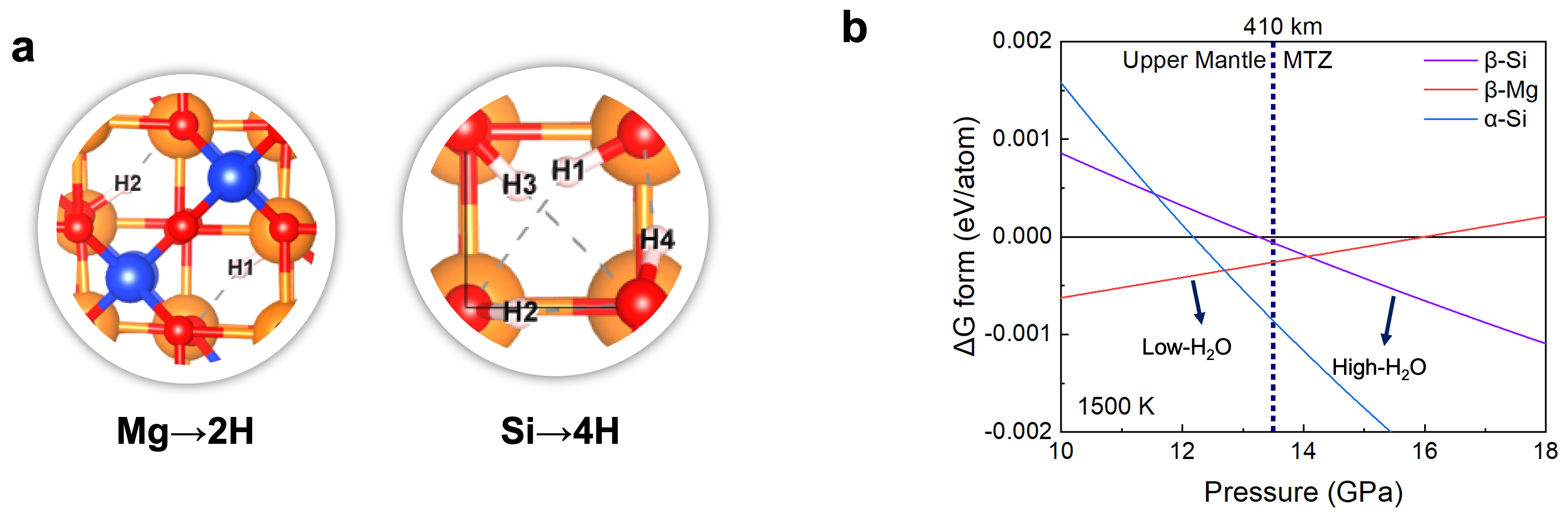 Fig. 1: Stabilities of predicted hydrous minerals. (a)The illustrations of hydrogen substitution on Mg site and Si site. (b) Gibbs free energies of α-Si, β-Mg and β-Si by quasi-harmonic approximation (QHA).
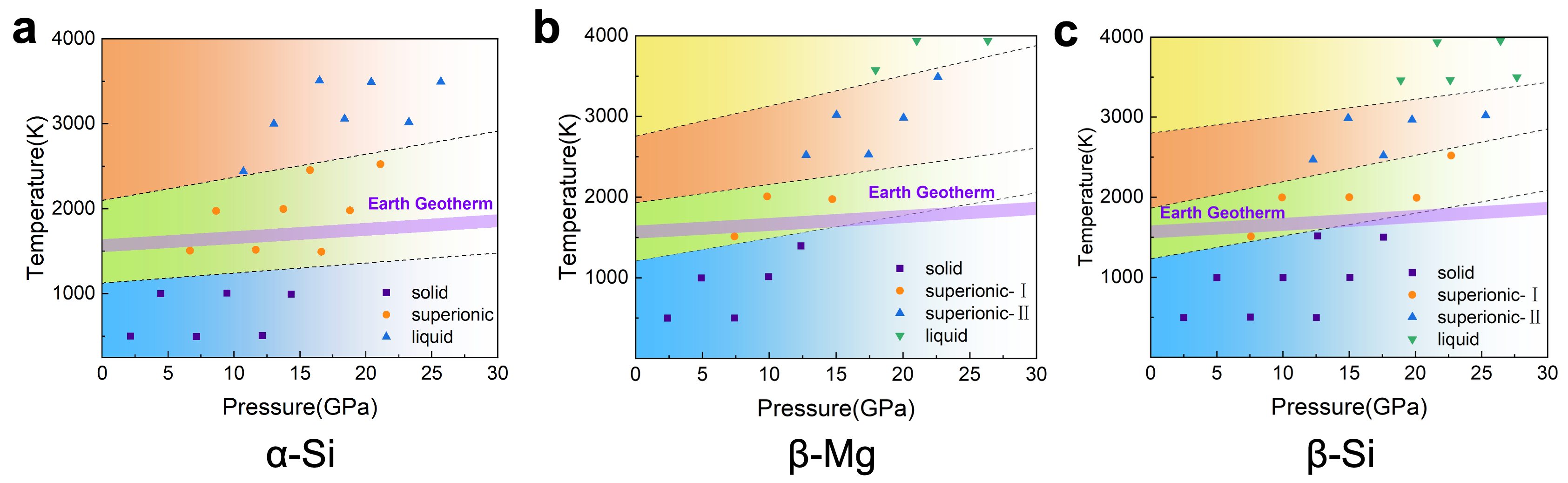 Fig. 2: The phase diagram of α-Si (a), β-Mg (b) and β-Si (c). The purple squares, red circles and blue triangle represent solid states, superionic states and liquid states, respectively and the wide purple line represents the Earth geotherm.
Moreover, through machine-learning molecular dynamics simulations, the team discovered a dual superionic state in hydrous wadsleyite and ringwoodite. The simulations show that above 2000 K, these hydrous minerals undergo two superionic transitions: first into a hydrogen superionic state, in which the oxygen sublattice forms a rigid framework while H⁺ ions diffuse freely through interstitial sites; as temperature increases further, Mg²⁺ ions also begin to diffuse, forming a dual superionic state with both H⁺ and Mg²⁺ diffusion. In this dual superionic state, the diffusion rate of H⁺ can be an order of magnitude faster than that of Mg²⁺, and their cooperative migration provides a new pathway for material transport in the mantle transition zone. Additionally, the enhanced conductivity of hydrous phases in this dual superionic state at high temperature may influence the Earth’s internal magnetic field.
北京高压科学研究中心Duckyoung Kim团队通过晶体结构预测与第一性原理计算发现,在约410 km深度附近,瓦兹利石中存在压力驱动的氢位点转移机制——H⁺选择性地从Mg²⁺位点迁移至Si⁴⁺位点,这一转变同时伴随瓦兹利石电导率的显著下降,意味着若不考虑该氢转移效应,基于电导率估算的过渡带含水量可能存在显著偏差。此外,研究还发现,在超过2000 K的高温下,含水瓦兹利石与林伍德石会呈现双超离子态,H⁺与Mg²⁺同时表现出高离子迁移性,这一现象对地球的物质传输、电导率及地磁场产生具有重要意义。相关成果以“Hydrogen site-dependent physical properties of hydrous magnesium silicates in the mantle transition zone”为题,发表于《自然·通讯》(Nature Communications),论文第一作者为北京高压科学研究中心王子范博士。


自由 Freedom
合作 Collaboration
顶尖 Excellence