
EN
About 1, 200–1, 400 kilometers beneath the Moon’s surface lies a mysterious phenomenon that has puzzled scientists for nearly half a century: seismic waves suddenly slow down when passing through this region, creating a peculiar low-velocity zone. Recently, an international team led by Dr. Yanhao Lin from the Center for High Pressure Science and Technology Advanced Research (HPSTAR) published their latest findings in Nature Communications, using experimental simulations to finally unravel the mystery. For the first time, in-situ high-pressure and high-temperature experiments combined with thermodynamic modeling revealed that the lunar core-mantle boundary is not a static, unchanging interface but a continuously active chemical reaction zone. The study shows that a new lunar mantle mineral—iron-rich magnesiowüstite—forms at the lunar core-mantle boundary, which is responsible for the characteristic low-velocity anomaly in the Moon’s deep interior. This discovery fundamentally reshapes our understanding of the Moon’s internal structure and evolutionary history.
Since the Apollo lunar missions of the last century, scientists analyzing moonquake data have confirmed the presence of a pronounced low-velocity layer at the lunar core-mantle boundary—the interface between the metallic lunar core and the rocky mantle. Seismic waves that usually propagate steadily noticeably “slow down” here, with both P-wave and S-wave velocities dropping sharply. This indicates that the composition of the Moon’s deepest materials is markedly different from the standard mantle rocks previously assumed.
To explain this phenomenon, several hypotheses have been proposed: some suggest residual magma pockets, others attribute it to partial melting from mantle overturn, and some speculate it could be iron-sulfur liquids. However, none of these models fully reconcile observational data with the Moon’s chemical composition and thermal history.
More importantly, the traditional view long held that the lunar core is metallic, the mantle is rocky, and the two remain chemically isolated. Yet the anomalous signals from the Moon’s interior suggest a more complex reality.
To solve this scientific puzzle, Dr. Yanhao Lin’s team (LEAP Lab) simulated the extreme conditions of the lunar core-mantle boundary in the lab: pressures tens of thousands of times Earth’s atmosphere, temperatures exceeding 1, 200°C, and oxygen fugacity conditions matching those deep inside the Moon.
The researchers placed olivine—the main mineral of the lunar mantle—together with metallic iron representing core material in high-pressure and high-temperature experiments. What surprized the scientistst was that under the influence of oxygen, olivine directly reacted with iron to produce a previously unrecognized lunar mineral—iron-rich magnesiowüstite ((Fe,Mg)O).
This discovery overturns the long-standing belief that the core and mantle do not react, proving that the Moon’s core and mantle have continuously undergone chemical reactions over billions of years, producing new minerals at their interface.
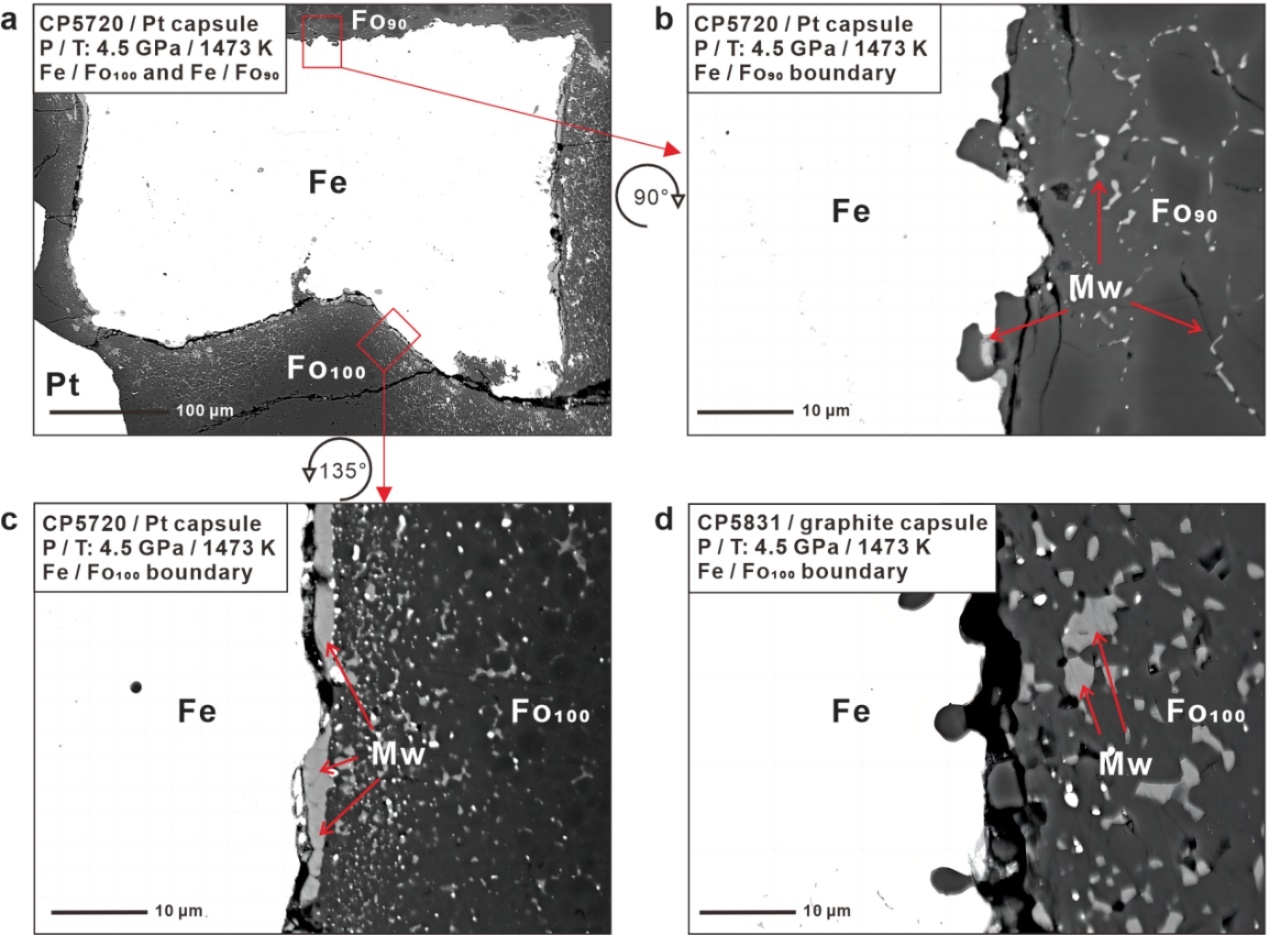
Figure 1: Representative backscatter images of olivine reacting with iron at 4.5 GPa, 1473 K. (b) and (c) are magnified views of (a). (a), (b), and (c) are from platinum sample capsules; (d) is from graphite sample capsules.
Further in-situ sound velocity measurements and thermodynamic calculations indicate that iron-rich magnesiowüstite has seismic velocities far lower than other lunar minerals. Occupying just 5–15% of the rock, combined with minor melt, it perfectly reproduces all features of the Moon’s low-velocity zone, resolving a decades-long mystery about the Moon’s deep interior.
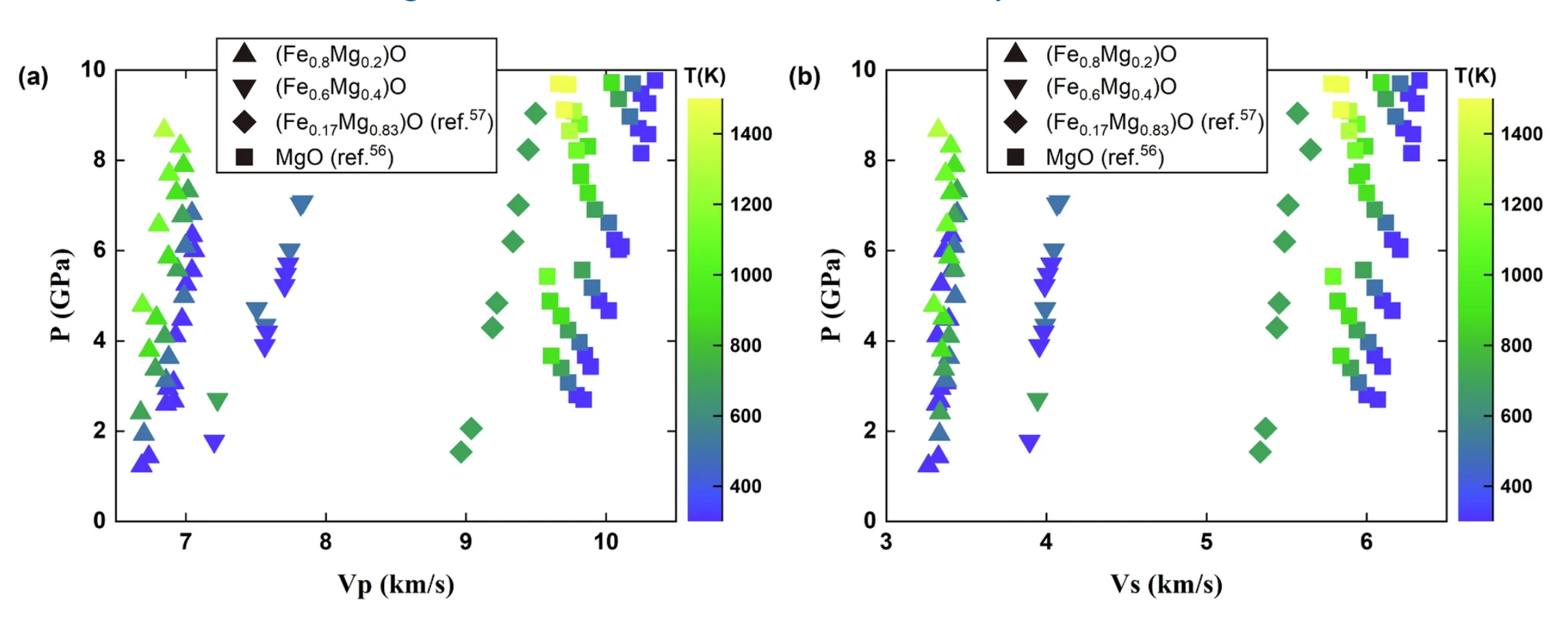 Figure 2: Schematic of P-wave (a) and S-wave (b) velocities of magnesiowüstite versus temperature and pressure. (Fe0.8Mg0.2)O (this study), (Fe0.6Mg0.4)O (this study), (Fe0.17Mg0.83)O, and MgO experimental data are indicated by triangles, inverted triangles, squares, and diamonds, respectively.
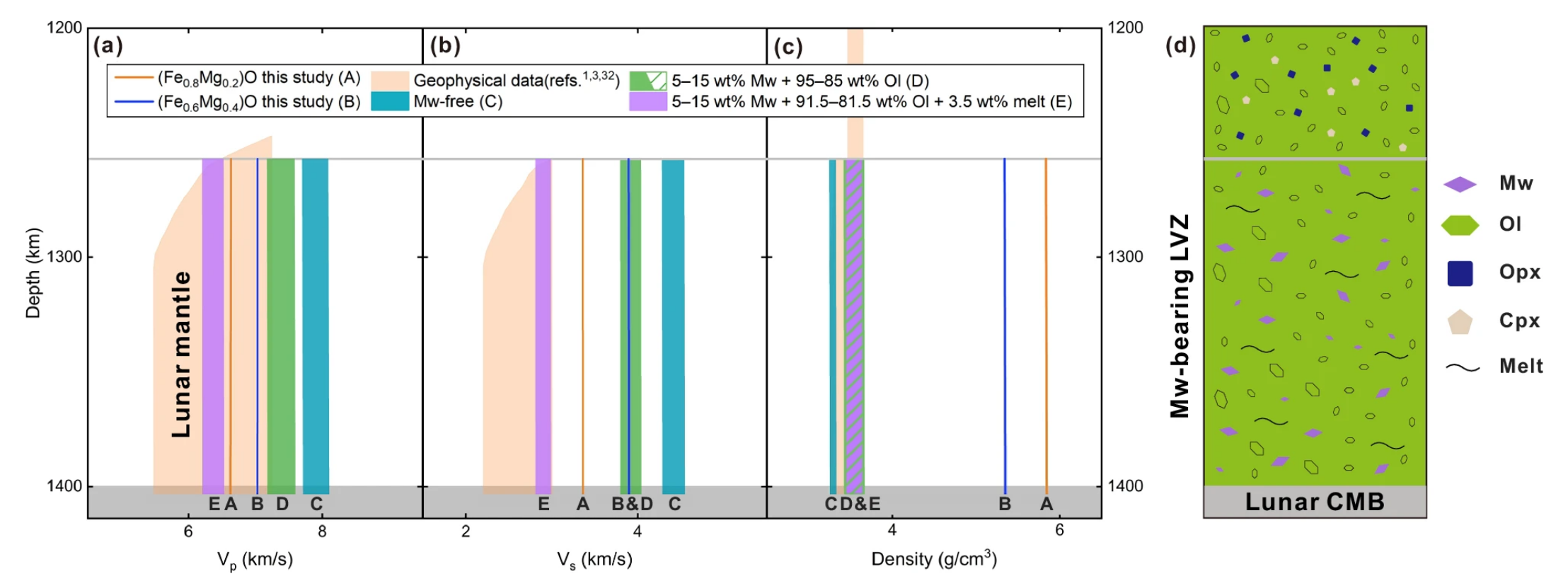
Figure 3: Comparison of experimental and calculated P-wave (a), S-wave (b), and density (c) at the lunar core-mantle boundary. (d) Schematic of the mineral assemblage at the lunar core-mantle boundary based on this study.
"During the Moon’s formation, extremely high temperatures allowed large amounts of oxygen to dissolve in the molten metallic core. As the Moon gradually cooled, the solubility of oxygen in the metal dropped sharply. Oxygen could no longer remain stable in the core and was continuously released toward the core-mantle boundary. This “escaping” oxygen enabled olivine and iron to react, ultimately forming a stable layer of iron-rich magnesiowüstite," explained Dr. Yanhao Lin.
“This mechanism also applies to rocky planets such as Earth and Mars. The core-mantle boundary of rocky planets is not a static interface but an active chemical reaction zone. It opens a new window for exploring the internal structure and evolutionary history of rocky planets in the Solar System,” added Dr. Yanhao Lin.
The first author is PhD student Xu Qianzhi from the Beijing Center for High Pressure Science, and the corresponding author is Lin Yanhao. International collaborators include Prof. Wim van Westrenen (Vrije Universiteit Amsterdam, Netherlands), Prof. Steeve Gréaux (Ehime University, Japan), and Prof. Yoshio Kono (Kwansei Gakuin University, Japan) etc.


自由 Freedom
合作 Collaboration
顶尖 Excellence