


Yang Ding
Associate Director & Staff Scientist
Extreme Quantum Materials Discovery
Yang Ding’s team investigates the emergent electrodynamics of quantum materials under high pressure, employing synchrotron X-ray, laser spectroscopic, and transport methods, along with theoretical modeling. Their research primarily targets breakthroughs in Mott physics, high-temperature superconductivity, and topological properties.
Research Directions
Selected Publications
Pressure-induced 18 K superconductivity and two superconducting phases in CuIr2S4
Unveiling a Novel Metal-to-Metal Transition in LuH2: Critically Challenging Superconductivity Claims in Lutetium Hydrides
Novel valence transition in elemental metal europium around 80 GPa
Solids, liquids, and gases under high pressure
Pressure-induced confined metal from the Mott insulator Sr3Ir2O7
Novel high-pressure monoclinic metallic phase of V2O3
Pressure-induced magnetic transition in manganite (La0.75Ca0.25MnO3)
Novel pressure-induced magnetic transition in magnetite (Fe3O4)
Structural phase transition of vanadium at 69 GPa
Featured Research Infrastructure
Platform
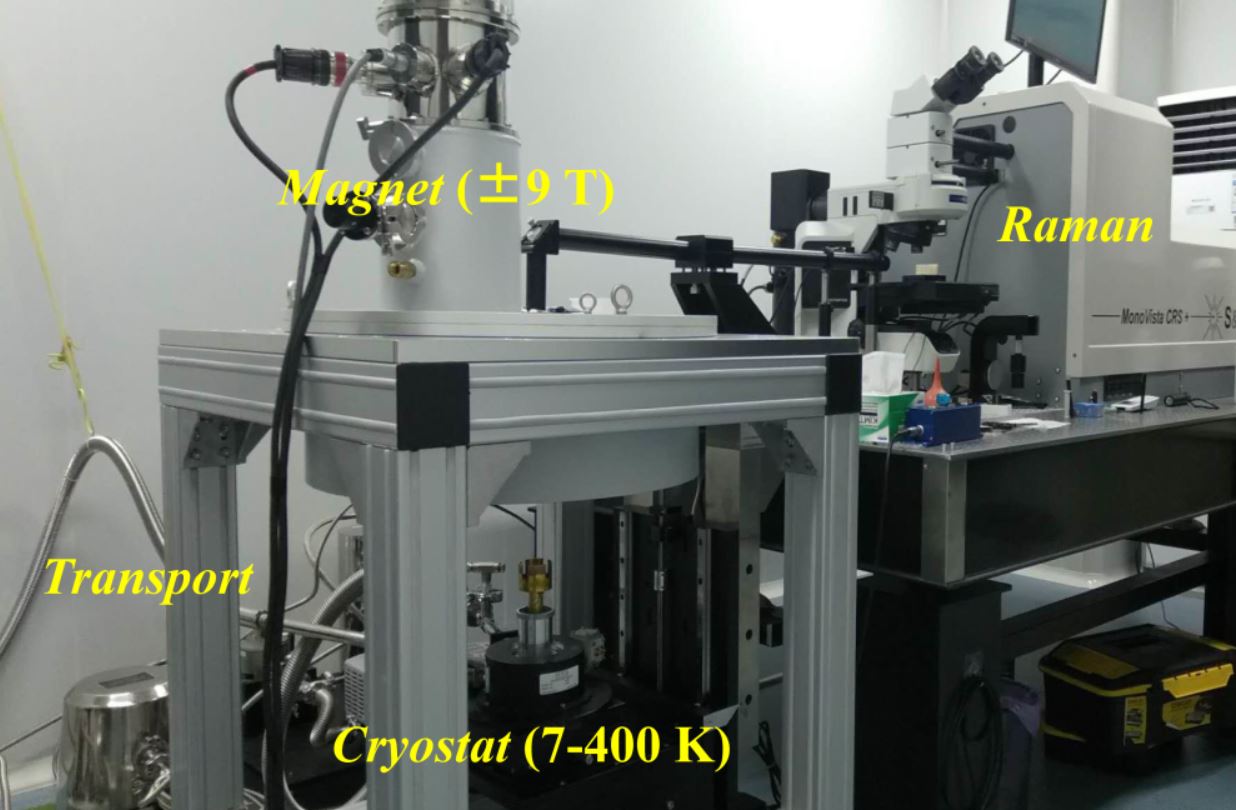
Integrated Physical Property Measurement System
Designed in-house around key scientific problems, this platform integrates low temperature, strong magnetic fields, and high pressure for synchronized structural and electrical characterization.
Magnetic field up to ±9 T · Operating temperature 7–400 K