
EN
Electrides are a unique class of exotic materials in which electrons reside in the empty spaces (interstitial voids) between atoms rather than orbiting atomic nuclei, acting as anions. Because these interstitial anionic electrons (IAEs) are only weakly bound, their dimensionality and spatial distribution are highly sensitive to external stimuli. Ca2N, a prototypical two-dimensional electride, has attracted broad interest due to its high electron mobility and low work function at ambient conditions. While the team have experimentally observed a pressure-induced metal-to-semiconductor transition at relatively low pressures (Adv. Sci. 5, 1800666 (2018)), the structural evolution and the underlying behavior of IAEs under extended compression have remained largely unexplored. To address this, a research team led by Dr. Huiyang Gou at the Center for High Pressure Science and Technology Advanced Research (HPSTAR) has systematically investigated the high-pressure behavior of Ca2N up to 120 GPa, combining crystal structure prediction with first-principles calculations. Their study, published in Physical Review B and selected as an Editors’ Suggestion, reveals an unexpected non-monotonic electronic metal-semiconductor-metal transition.
As visualized in their theoretical model, the transition is governed entirely by the behavior of interstitial electrons. Upon initial compression, the extended two- and three-dimensional IAE networks collapse into localized zero-dimensional states, opening a band gap and turning the material into a semiconductor. Surprisingly, with further compression, the shrinking interstitial volume forces these trapped electrons to interact and rehybridize with the surrounding Ca-d orbitals. This rehybridization broadens the electronic states, freeing the electrons and restoring the material's metallic state.
“We were surprised to find that Ca2N returns to a metallic state at higher pressures,” said Dr. Liang. “This non-monotonic behavior reveals that interstitial electrons are not merely passive spectators—their dimensionality, localization, and hybridization act as key knobs for tuning electronic properties.”
This study establishes the high-pressure structural and electronic phase diagram of Ca2N and provides a unified microscopic framework for understanding pressure-driven phenomena in electrides. Furthermore, understanding this “electron switch” offers new opportunities for designing future functional quantum materials and electrides.
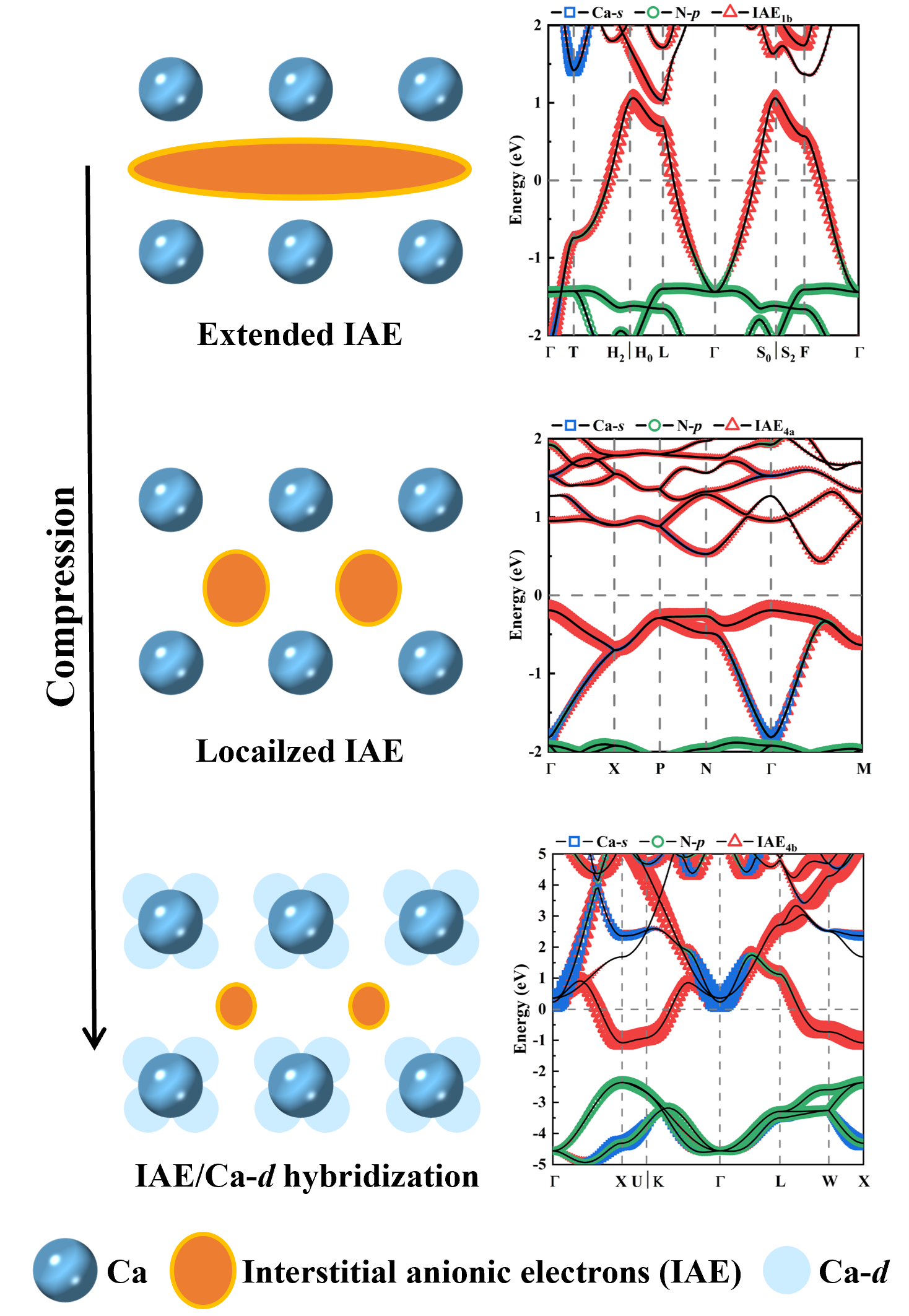
Caption: Schematic of the pressure-driven metal-semiconductor-metal transition in Ca2N, illustrating the evolution of extended IAEs into localized states and their subsequent rehybridization with Ca-d orbitals, alongside the corresponding projected band structures.
电子化合物是一类特殊的材料,其中部分电子游离于原子间隙之中,充当阴离子的角色(即间隙阴离子电子,IAEs)。由于这些电子受原子核束缚较弱,其空间维度与分布对外界压力极为敏感。作为典型的二维电子化合物,Ca2N在常压下展现出高电子迁移率和低功函数等优异特性。然而,在宽压力范围内,其晶格结构如何演化,以及间隙电子在其中扮演何种角色,长期以来缺乏清晰的微观图像。针对这一问题,北京高压科学研究中心缑慧阳研究员团队结合晶体结构预测与第一性原理计算,系统研究了Ca2N在高达120 GPa 压力下的结构演化与电子相变行为。研究发现,随着压力升高,Ca2N并非简单地保持金属或半导体态,而是经历了一场奇异的“金属→半导体→金属”非单调转变。研究团队通过理论模型揭示了这一现象背后的物理机制:在初始加压阶段,原本扩展的IAE网络局域分割为零维状态,导致带隙打开(金属变为半导体);而进一步加压时,极度压缩的空间迫使局域电子与周围的Ca-d轨道发生杂化,使电子态重新展宽,恢复了金属性。该工作不仅建立了Ca2N的完整高压相图,更重要的是,提供了一套统一的微观框架,阐明了间隙电子的维度、局域化程度及杂化行为是调控电子化合物电学性质的关键“旋钮”。这一发现为未来设计新型功能量子材料提供了重要的理论指导。相关成果以“Pressure-driven metal-semiconductor-metal transition in Ca2N: Localization and hybridization of interstitial electrons”为题发表于《物理评论B》(Physical Review B),并入选编辑推荐(Editors’ Suggestion)。


自由 Freedom
合作 Collaboration
顶尖 Excellence