
EN
Layered Janus materials, characterized by chemically distinct atomic environments on opposite sides of a metal layer, represent an emerging class of materials with structural and physical properties extending beyond those of conventional transition-metal dichalcogenides. However, few bulk Janus materials have been experimentally realized, and their structural and physical responses to compression remain largely unexplored. A research team led by Dr. Huiyang Gou, Dr. Jun Deng, and Dr. Kefeng Liu at the Center for High Pressure Science and Technology Advanced Research (HPSTAR), in collaboration with national and international researchers, previously reported the successful growth of single crystals of the bulk Janus material RhSeCl (Advanced Science 12, e05279 (2025)). Building on this work, the team has systematically investigated the structural and electronic evolution of RhSeCl under high pressure, revealing a series of structural phase transitions accompanied by the emergence of nodal-ring semimetallicity and superconductivity. The findings have recently been published in the Journal of the American Chemical Society.
At ambient pressure, Janus RhSeCl crystallizes in a hexagonal structure, in which Se and Cl atoms occupy opposite sides of each Rh layer, forming two-dimensional Janus layers held together by van der Waals (vdW) interactions. High-pressure X-ray diffraction measurements reveal a sequence of structural transitions from the hexagonal phase through monoclinic and orthorhombic intermediate phases to a tetragonal structure. The distinct structural responses of the Se and Cl sublayers, together with intralayer distortions, drive a change in the local coordination of Rh atoms from a quasi-octahedral RhSe3Cl3 environment to a quasi-cubic RhSe4Cl4 environment at high pressure. Meanwhile, increasing compression strengthens the interlayer interactions, which evolve from predominantly vdW interactions toward covalent-like bonding, ultimately connecting the individual layers into a three-dimensional bonded framework.
These structural transformations are accompanied by substantial changes in the electronic properties of RhSeCl. First-principles calculations predict a pressure-induced semiconductor-to-metal transition, consistent with electrical transport measurements that indicate metallization near 80-90 GPa. The calculations also identify an intermediate nodal-ring semimetallic state, arising from band crossings involving Rh-d and Se/Cl-p states and protected by mirror and glide symmetries. Superconductivity emerges above approximately 90 GPa as the material evolves toward the tetragonal phase. Electron–phonon coupling calculations further suggest that superconductivity is primarily associated with strong coupling between low-frequency Rh-dominated phonon modes and in-plane Rh-d electronic states within the square Rh lattice.
This study establishes a microscopic connection between asymmetric atomic responses, interlayer bonding reconstruction, and the emergence of distinct electronic states in a bulk Janus material. The findings highlight structurally flexible mixed-anion compounds as promising platforms for exploring pressure-induced electronic phases and provide a potential route toward discovering superconductors through pressure-driven reconstruction of bonding frameworks.
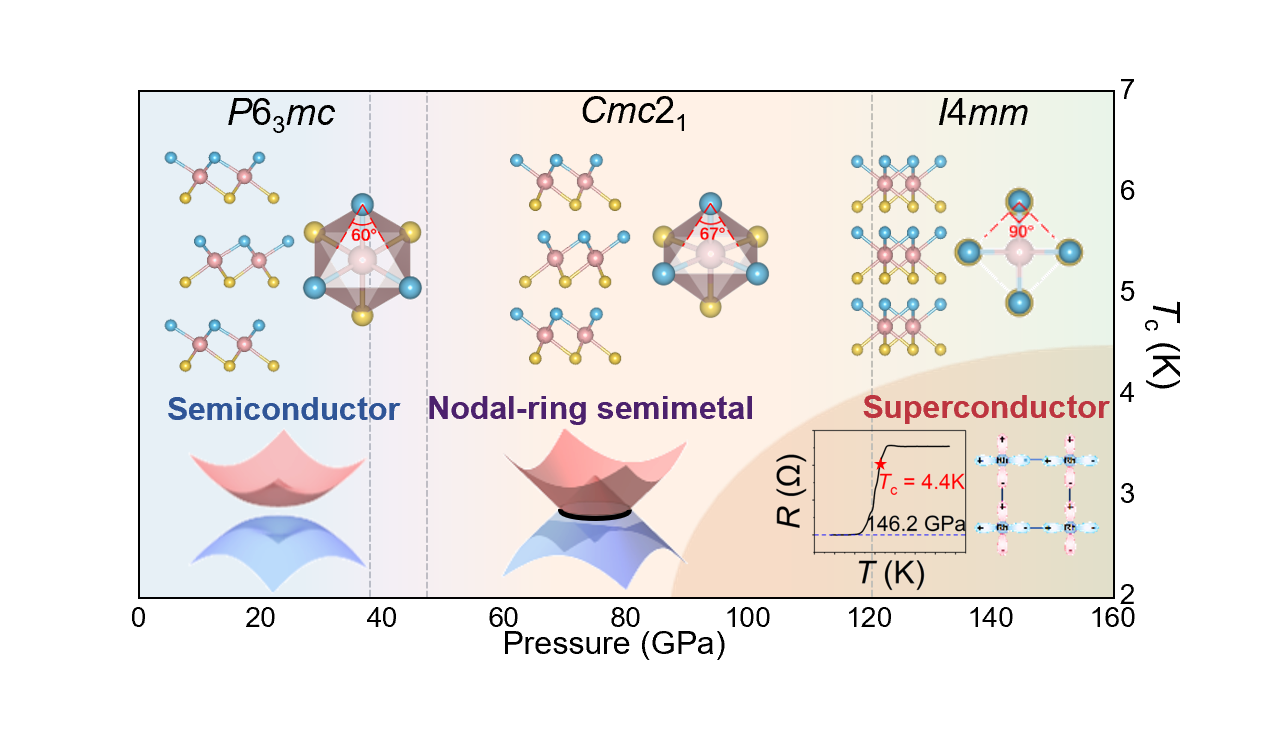
Caption: Pressure-induced structural reconstruction and emergent electronic states of Janus RhSeCl, illustrating the evolution toward a tetragonal framework accompanied by metallization and superconductivity.
近日,北京高压科学研究中心缑慧阳研究员团队在前期成功制备毫米级Janus材料RhSeCl单晶的基础上(Advanced Science 12, e05279, 2025),进一步开展了系统的高压结构与物性研究,揭示了RhSeCl由六方结构经单斜、正交结构向四方结构演变的多阶段结构相变过程。随着压力升高,Janus层两侧的Se和Cl原子表现出不同的结构响应,Rh原子的局域配位环境也随之发生改变。与此同时,层间相互作用逐渐增强,由弱范德华相互作用向具有显著共价特征的成键方式演变,最终形成三维成键网络。伴随晶体结构与成键方式的重构,RhSeCl的电子性质发生显著变化。在约80-90 GPa压力范围内,材料由半导体转变为金属,并在这一演化过程中出现节点环半金属态;当压力超过约90 GPa时,体系出现超导电性,进一步加压后实现零电阻。理论计算表明,超导电性的出现与高压四方结构密切相关,主要源于Rh原子四方平面内的d电子态与低频Rh声子模之间较强的电子–声子耦合。该研究揭示了高压下Janus材料非对称原子响应、层间成键重构与电子态演化之间的内在联系,表明压力不仅能够驱动层状材料的结构转变,还可通过调节局域配位环境和成键网络,诱导新的电子态及超导电性的出现。研究结果深化了对Janus材料高压结构演化及其物性调控机制的认识,并为通过压力诱导成键网络重构探索新型超导材料提供了新的思路。相关成果近日发表于《美国化学会志》(Journal of the American Chemical Society)。


自由 Freedom
合作 Collaboration
顶尖 Excellence