
EN
New research from a team of scientists led by Dr. Charles Zeng from the Center for High Pressure Science and Technology Advanced Research (HPSTAR) has experimentally established a direct causal link between high-temperature liquid polymorphism and the glass polymorphs quenched from such liquids in metallic alloy systems. This breakthrough was realized via in situ high-pressure high-temperature synchrotron X-ray diffraction measurements. The work published in Nature Communications, delivers definitive, pivotal experimental evidence proving that densely packed metallic alloys host structurally distinct liquid phases and their matching glassy counterparts, resolving a decades-long unresolved scientific debate.
Whether polymorphism—a phenomenon where substances share the same composition but possess different atomic structures, commonly seen in crystals—is universally present in liquids and glasses has always been a highly debated puzzle in the amorphous materials field. Previously, such phenomena were mainly observed in substances with open network structures, such as water, sulfur, and phosphorus. Furthermore, the key question of whether polymorphism in glasses originates from polymorphism in liquids has remained controversial.
To solve this puzzle, the research team cleverly designed an in situ experimental scheme. They selected two typical metallic glass-forming alloys—palladium-based and magnesium-based alloys—and utilized a diamond anvil cell combined with in situ synchrotron X-ray diffraction and double-sided laser heating techniques. Under extreme pressure-temperature conditions of up to 30 GPa and 2600 K, they tracked the structural evolution of the materials across different states in real time. The experimental results revealed that under varying pressures, the liquid metal exhibits two distinct states with different structures and densities: a high-density liquid and a low-density liquid. More importantly, the glasses obtained by directly quenching these two different liquids also display significantly different structural characteristics. This difference is preserved even after decompression, resulting in stably recoverable high-density and low-density glasses.
Detailed structural analysis of the palladium-based alloy showed that in the pressure range of approximately 10-15 GPa, the structural parameters of the liquid metal underwent a cooperative transition, with pressure driving the liquid to transform into a higher-density, more compact structure. The glass obtained by quenching this high-pressure liquid showed a density increase of about 3% compared to the original glass. Comprehensive microstructural characterization and elemental analysis of the recovered samples also ruled out interfering factors such as nanocrystallization or phase separation, confirming that the observed changes indeed stem from the polymorphic differences within the amorphous structure itself.
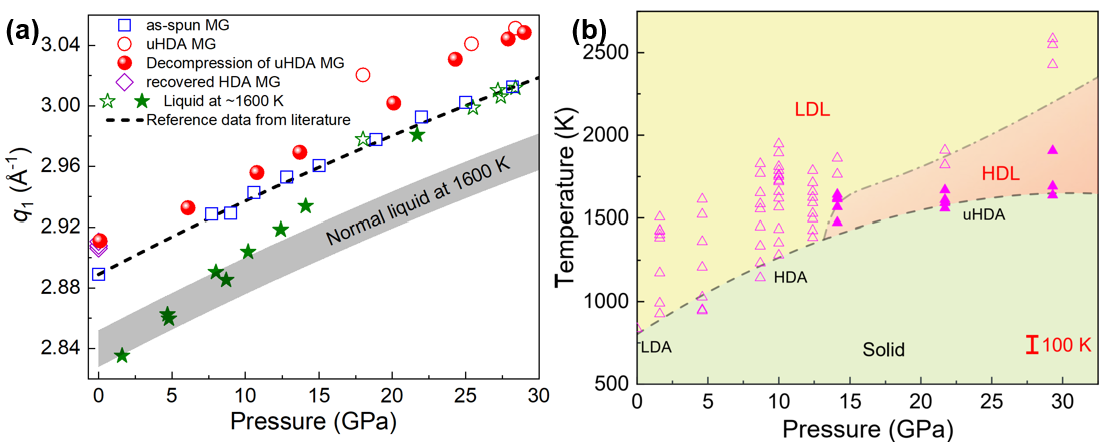 Caption: (a) Structural characteristic parameters and (b) the temperature-pressure metastable boundary diagram for different states in the palladium-based metallic glass system.
This study reveals, for the first time in densely packed metallic systems, the universal existence of liquid and glass polymorphism, directly linking the polymorphic behaviors of the liquid and glassy states. This not only provides a solid experimental foundation for understanding the energy landscape of amorphous materials but also suggests that the structural diversity of liquids and glasses in nature may far exceed our previous understanding.
曾桥石研究员团队通过同步辐射高温高压原位X射线衍射实验,首次在金属合金中,建立了高温液体与其经快速冷却形成的玻璃之间“多形态”(polymorphism)的直接对应关系,从实验上证实了即便在原子密堆积的金属合金中,也存在多种结构不同的液态和对应玻璃态,为澄清长期困扰学界的相关争议提供了直接的关键实验证据。相关成果以“Direct correspondence between liquid and glass polymorphism in densely packed metallic alloys”为题近日在线发表于《自然·通讯》。


自由 Freedom
合作 Collaboration
顶尖 Excellence