
EN
Understanding how supercooled liquids circumvent crystallization to "freeze" disordered structures into glasses remains a central, long-standing challenge in glass science and condensed matter physics. Recently, a research team led by Dr. Charles Zeng from HPSTAR made significant progress in this field. Published online in Nature Communications, their study titled “Competing structural orders frustrate crystallization in a metallic glass” provides direct experimental evidence that structural competition can frustrate crystallization and stabilize the glassy state. These findings offer fundamental insights into the intricate relationship between structural frustration and stability in metallic glasses.
A prevailing theory suggests that glasses harbor multiple, mutually incompatible local structural motifs. Their competitive coexistence hinders the development of long-range periodic order—a phenomenon termed "structural frustration"—thereby suppressing crystallization. However, experimentally confirming the existence of this frustration in amorphous systems has long been a formidable challenge.
Focusing on a Cu46Zr42Al7Y5 metallic glass, the team employed in-situ high-energy synchrotron X-ray diffraction combined with conventional and ultrafast differential scanning calorimetry (DSC). They conducted experiments across a wide range of heating rates—from 300 down to 0.167 K/s, spanning three orders of magnitude. Intriguingly, the first exothermic peak in the heating curve exhibited a "dual character": At high heating rates: It manifested as conventional crystallization. At low heating rates: It transformed into an ordering transition characteristic of polyamorphism.
This directly contradicts the conventional wisdom that faster heating suppresses crystallization. Further kinetic analysis revealed that at lower heating rates, crystallization encountered an effective "frustration," evidenced by an anomalous increase in activation energy.
Probing the structural origins, the researchers found that as heating slowed, the onset temperature of crystallization dropped below the conclusion temperature of the glass transition. While the thermodynamic driving force for ordering was awakened prematurely, the system remained shackled by sluggish glassy dynamics. Atomic cooperative motion and long-range diffusion were insufficiently activated, preventing “crystal-like” local order from expanding into long-range arrangements. Structural analyses further corroborated the “competition” scenario: rather than undergoing two sequential ordering processes, the system experienced two distinct structural transitions at their respective characteristic temperatures. The overlap and coupling of these transitions induced structural frustration. Notably, the structural correlation length increased during both pre-ordering and ordering stages. Conversely, the wave vector of medium-range density waves exhibited opposite trends: it contracted during pre-ordering but expanded during the subsequent ordering stage. This behavior—an overall trend toward orderliness juxtaposed with opposing ordering mechanisms—provides direct evidence of structural competition.
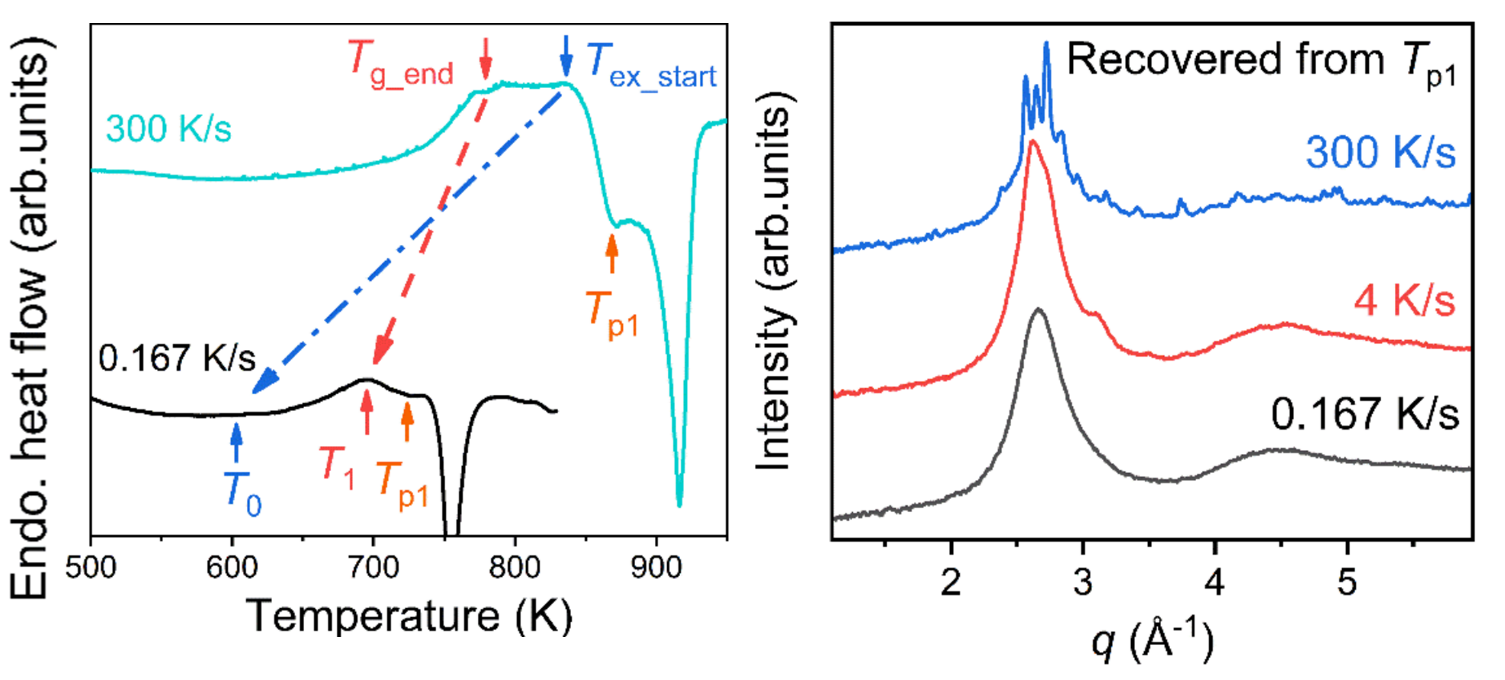
Caption: Left: Schematic illustration of the heating -rate -dependent crossover between Tex_start and Tg_end. Right: XRD patterns of samples recovered from Tp1 with different heating rates.
This work provides direct experimental evidence that competing local structural orders frustrate crystallization and stabilize the glassy state. It opens new avenues for understanding the “devitrification” pathways of amorphous materials and establishes heating rate as a tunable parameter, offering promising strategies for actively modulating the stability and properties of metallic glasses.
理解过冷液体如何规避结晶、将无序结构“冻结”成玻璃,是玻璃科学与凝聚态物理长期未解的核心问题之一。北京高压科学研究中心的曾桥石研究员团队在该领域取得进展。研究团队以Cu₄₆Zr₄₂Al₇Y₅金属玻璃为模型体系,结合高温原位高能同步辐射X射线衍射与常规及超快差示扫描量热方法,在300至0.167K/s、跨越三个数量级的加热速率范围内展开研究。结果发现,该金属玻璃加热曲线的第一个放热峰竟有“两副面孔”。高速加热时表现为常规晶化,低速加热时却转变为非晶多形态的有序化转变。这与“加热越快越抑制晶化”的常识相悖。动力学分析进一步揭示,低速加热时晶化反而遭遇有效“阻挫”,激活能反常升高。这项工作为“竞争性局域结构序能阻挫晶化、稳定玻璃态”提供了直接实验证据,为理解非晶材料的“去玻璃化”路径打开了新窗口,并把加热速率变为可调参量,有望主动调控金属玻璃的稳定性与性能。相关成果以“Competing structural orders frustrate crystallization in a metallic glass”为题在线发表于《自然·通讯》。


自由 Freedom
合作 Collaboration
顶尖 Excellence