
EN
A research team led by Profs. Eugene Gregoryanz, SHARPS and HPSTAR and Xiaodi Liu, Hefei Institute of Physical Science of Chinese Academy of Sciences (ISSP), has observed the ΔJ = 0 rotational excitation in dense hydrogen, deuterium and their mixture. In the fluid state and phase I the frequencies (energies) of the ∆J=0 transition for H2 and D2 do not scale either as rotational (by factor of 2) nor vibrational (by √2) modes and appear to be completely isotope independent. This independence on mass marks this transition as unique and a fundamentally different type of excitation from the commonly considered harmonic oscillator and quantum rotor. These interesting results were published in Physical Review Letters.
The hydrogen molecule (H2) is a paradigm of a fundamental system in quantum mechanic. Its simplicity, combined with the well-defined spectroscopic properties, makes it a textbook example for illustrating key concepts. In its gas/fluid states, its rotational transitions follow Raman selection rules (ΔJ = ±2). However, when hydrogen enters a high-pressure solid state, the crystal field environment alters its symmetry, leading to degeneracy lifting and theoretically permitting ΔJ = 0 transitions. However, because the excitation frequency is so close to the laser line and thus obscured by the Rayleigh scattering, this transition, which simply comes out of the selection rules, had never been directly captured experimentally.
Utilizing a high-performance, low-wavenumber, high-pressure, and low-temperature Raman spectroscopy system the team conducted systematic Raman spectroscopic measurements on dense hydrogen (H₂), deuterium (D₂), and their mixtures across a broad range of pressure and temperature conditions, unambiguously observing this "hidden" excitation signal for the first time. They found that in the gas/fluid state this excitation has zero Raman shift as theory suggests, but in the solid, the crystal field drives it away from the zero value e.g. ~150 cm−1 at above 100 GPa and 20-45 K for both isotopes. Furthermore, the frequency of the ΔJ = 0 transition exhibits complete isotope independence, representing a novel excitation mode distinct from traditional harmonic oscillators and quantum rotors. The research further revealed the unique behavior of this excitation during the ortho-para hydrogen conversion process, providing crucial experimental clues for understanding the evolution of hydrogen's quantum states under extreme conditions. Dr. Gregoryanz said: In fact, we have known that the “zero roton” (the name we have given to this excitation) is there for more than 10 years. We have observed it in our previous works going back to at least 2017 but we were always interested in something else and never had time to pursue the “zero roton”. It was very exciting to finally sort out and understand the effect, which kept popping up in our experiments being a nuisance.
The reported discovery thus not only completes the final experimental observation of all allowed rotational transitions in the dense hydrogen, revealing the complete manifestation of Raman selection rules modified by a crystal field, but also provides a unique example showcasing the novel physics emerging in fundamental quantum systems under extreme conditions.
The above work was supported by the National Natural Science Foundation of China, the Ministry of Science and Technology, the Ministry of Science and Technology, the Youth Innovation Promotion Association of the Chinese Academy of Sciences, and the Director’s Fund of the Hefei Institutes of Physical Science.
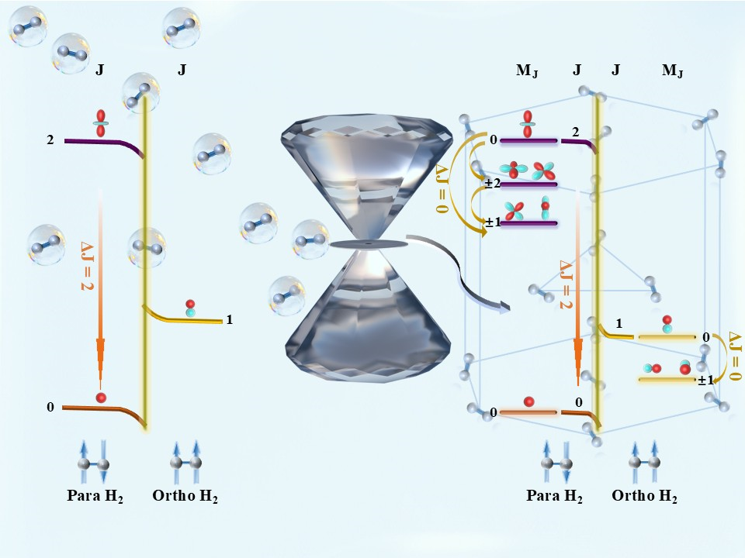
Caption: The translons behind the ΔJ = 0 excitation. The left part illustrates the rotational energy level diagram of hydrogen molecules in the gas/fluid state, while the right part is a schematic diagram showing the energy level splitting caused by the hexagonal crystal field.
近日,北京高压科学研究中心的Eugene Gregoryanz研究员与中国科学院合肥物质科学研究院固体物理研究所的刘晓迪研究员合作,在稠密氢(H2)、氘(D2)及其混合物中观测到了ΔJ = 0的转动激发。该研究发现在流体态和相Ⅰ中, H2和D2的ΔJ = 0跃迁频率(能量)既不遵循转动模式的比例因子(2),也不遵循振动模式的比例因子(√2),表现出完全的同位素无关性。这种对质量的独立性标志着该跃迁是一种区别于传统谐振子与量子转子的全新激发模式,这些有趣的研究结果发表在《物理评论快报》上。


自由 Freedom
合作 Collaboration
顶尖 Excellence